Sunday, August 18, 2024

Brookside Gardens

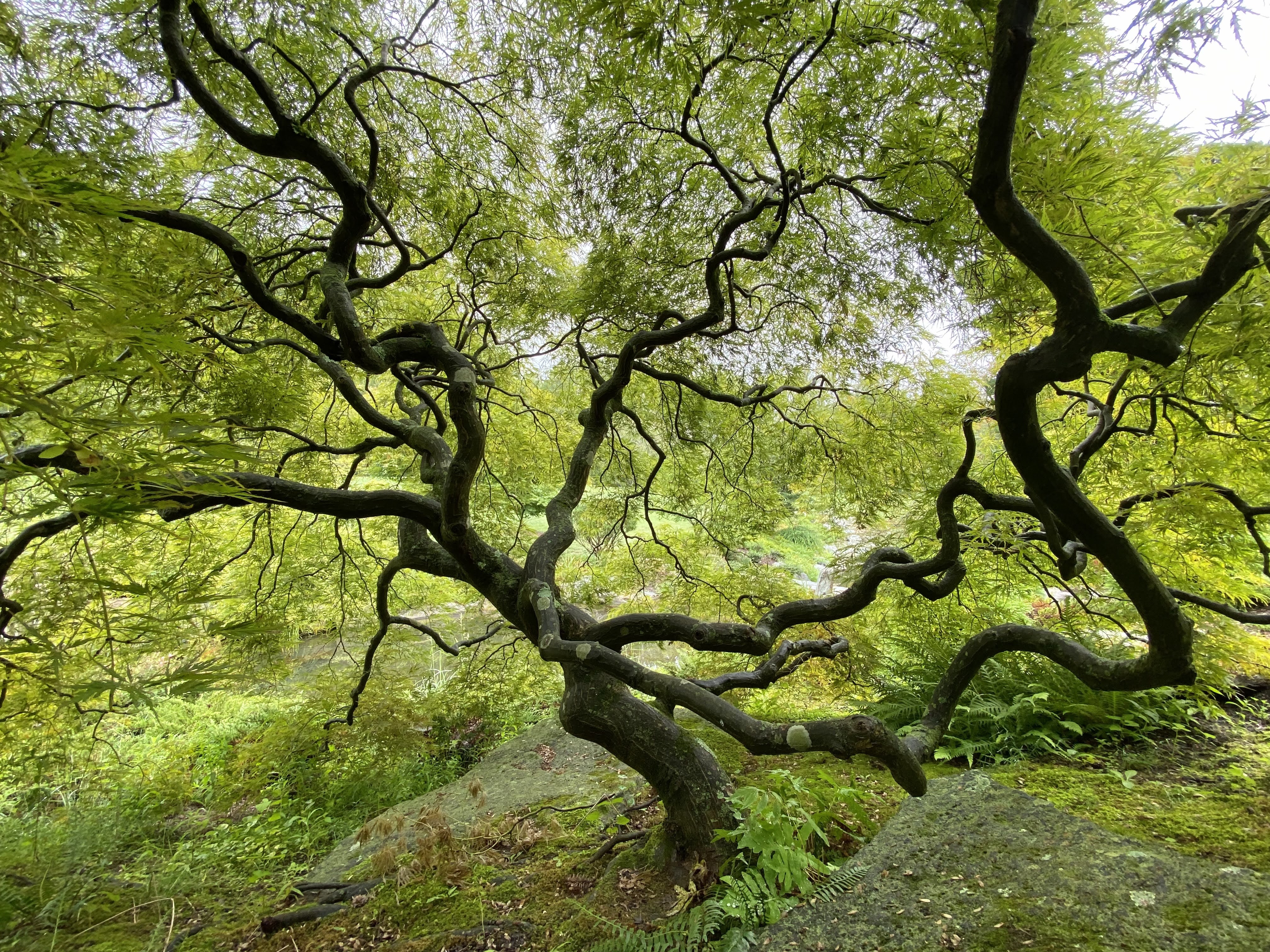
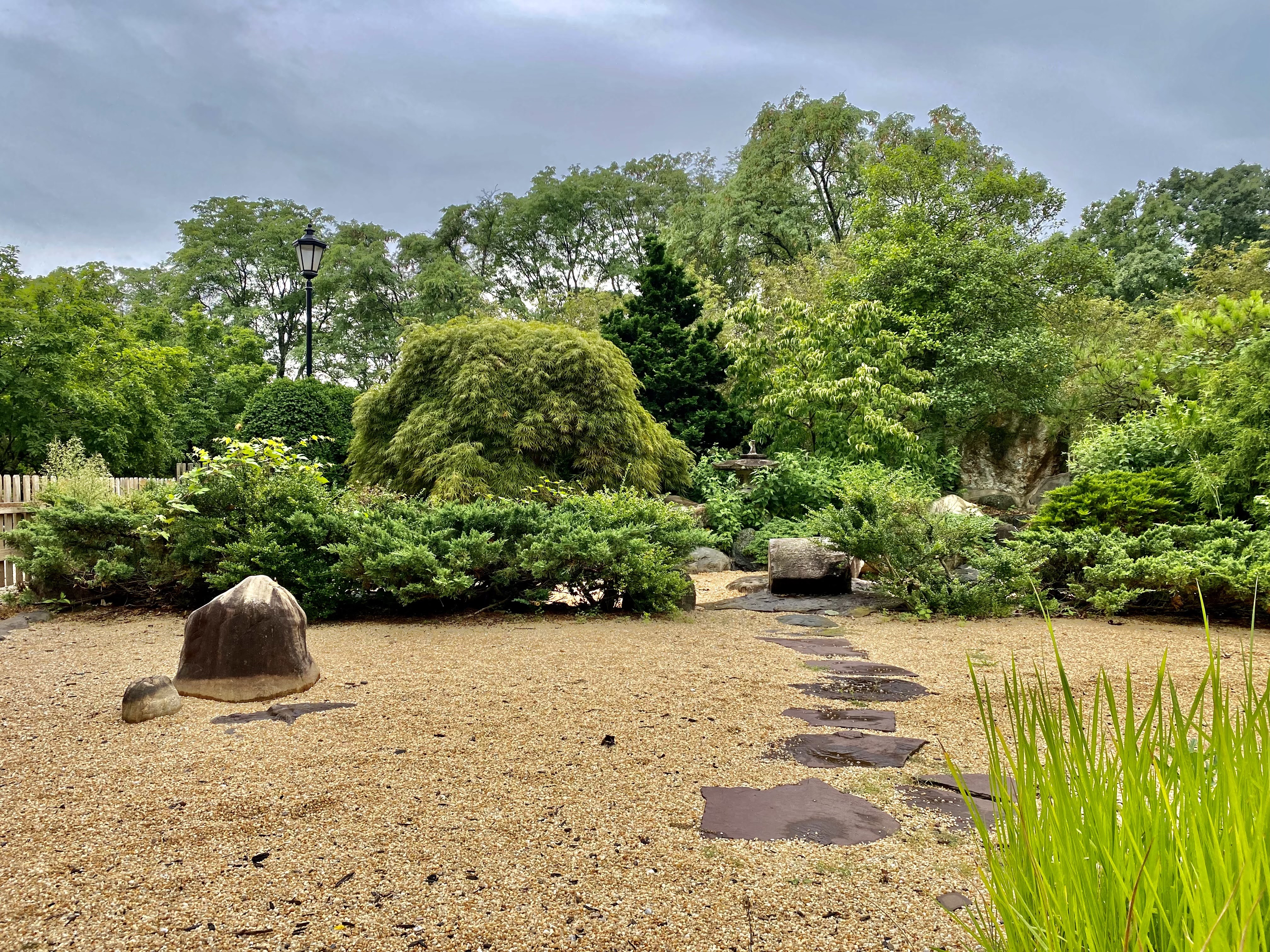
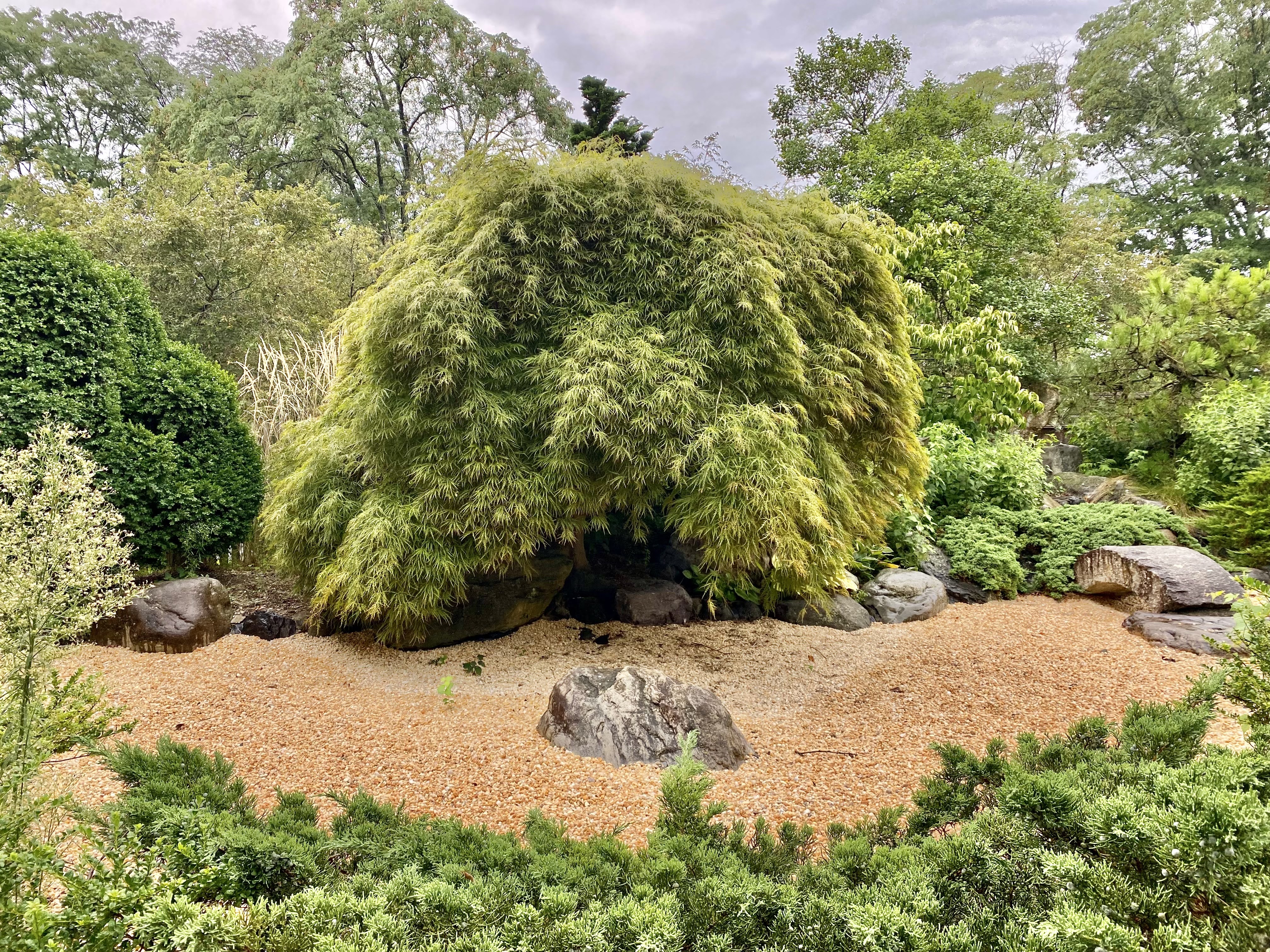
The Brookside Gardens are a public garden within the Wheaton Regional park in Wheaton, Maryland. The park consist of 50 acres and contains a number of garden areas, including a 1972 established Japanese style garden with a tea house known as the Gude garden.


When first approaching the Gude garden, one traverses a path that follows a series of rolling hills and ponds with a small island within. 


A Japanese style teahouse sits on the island and offers views across the ponds. Bamboo, conifers, and ground cover populate the island. Beech trees, blue Atlas cedar, souther magnolia and Kousa dogwood are all present. 


The island can be accessed via a number of small bridges, including a stone bridge that also acts as a water damn.


There are two large tori Sukiya-style gates that provide access to the teahouse. Not a traditional teahouse, the structure is more like a large open area platform with Japanese architectural features incorporated into the roof.


Trees and shrubs around the structure help tie it in to the larger island lanscape.


Overall, the garden was a pleasant experience. It was wonderful to behold from a distance, as well as take in the views from the teahouse. 


The Gude Garden is well worth a visit.

Saturday, August 17, 2024

Chanticleer Garden

Chanticleer, A Pleasure Garden, is a 48 acre botanical garden located in Wayne, Pennsylvania and built on the grounds of the Rosengarten estate. The estate was built in 1912 and a foundation established in 1946 to ensure its survival as a public garden. 

Website: https://www.chanticleergarden.org/

Technically, there is no Japanese or Chinese garden on site. Instead, there is an "Asian Wood" area that was first planted in 1995 and contains a large number of plant species from Korea, Japan, and China. 

I was initially hesitant to include this garden in the blog, but I have included other "Asian inspired" gardens in the past. One element that encouraged inclusion was a structure within the Asian Wood that remarkably resembled a Japanese Teahouse. 


Surrounded by bamboo and stylistically Japanese, the structure turned out to be a public restroom! Even the interiors appeared "Japanese."


The surrounding bamboo was impressive and its planting planned with a containment system to keep it from spreading.


Adjacent to the Asian Woods were also a series of garden rooms with stone pathways that were clearly Asian inspired.


An adjacent pond garden was full of lilies and Koi fish and added to the Japanese esthetic of these areas of the garden.


Although not a true Japanese garden, the elements and plantings throughout make it worthy of a visit, and there is no doubt that I have never experienced a more authentic looking public "Japanese garden toilet" outside of Japan.

The Garden of Serenity (Bethlehem Zen Garden)

The Garden of Serenity, located alongside the Bethlehem, Pennsylvania public library is a small Zen garden that was constructed in 1970 as part of a sister city relationship between the towns of Bethleham, PA and Tondabayashi, Japan that began in 1964.


Designed and built by Yoshinaga Sakon, the garden has many of he elements of an authentic Japanese garden. In fact, the materials for the garden and the teahouse where shipped from Japan and constructed on site. Cherry trees that were added in 1997 and 2014 help frame the backdrop of the garden. Starting in 2015 the Sister City Commission started an annual Bethlehem Cherry Blossom Festival which is widely attended by the local public.

The tea house is a nice size and the perfect location for public events such as tea ceremony demonstrations.


Although the back fence has aged considerably since it was first built, I liked the design. It looks remarkably similar to the design I used for my own stained Zen garden fence.


The plantings surrounding the gravel beds, and stone bridges has grown considerably since it was first built in 1971. As a result, the garden appeared overgrown and in need of some maintenance. 


It should be noted that the gravel bed in the following two images was a pond back in 2016. Its removal, unfortunately, undermines the authenticity of the garden.


Below is an image of the garden from 2014 and before the removal of the pond and the addition of a new dog-eared fence.

Source: Bethlehem Fine Arts Commission

The garden was clearly better maintained and the pond a significant feature of the garden.

The newly installed dog-eared picket fence now that surrounds the sides and front of the garden seemed out of place. I suspect the current fence was a cheaper money-saving alternative. 


I would identify the pond removal and fence changes as the major criticisms of the garden. The pond's absence removes a necessary water feature while the fence looks stylistically odd. However, more importantly, the fence and locked gate near the teahouse prohibits visitors from entering the garden and experiencing it directly. 

The fence essentially reduces the garden to a museum display and negates the purpose of a Japanese garden. The Itabashi Garden I recently visited in Burlington, ON, Canada, is similarly build adjacent to a public library, but it's design encourages visitors to view and walk through the garden. 

I understand the need to protect the garden from uninformed visitors and the role the fence plays in this regard. However, I would advocate for either a more authentic fence, or the planting of shrubs and plants that could act as a natural "barrier" to define the garden perimeter. Perhaps a designated entrance and separate exit-way could allow visitors to enter, stay on a path, and move through towards the exit. Also, without question, the pond should be reestablished. 

Correcting these mistakes would allow people to truly experience the joy of visiting a Japanese garden

Tuesday, July 23, 2024

Itabashi Garden

Special Note: the Itabashi Garden officially marks the 100 Japanese/Chinese garden that I have visited in North America!

Located behind the Tansley Woods Community Centre & library, in Burlington, Ontario, resides the Itabashi Garden. The garden officially opened on Canada Day, 2019 with delegates from both the city of Burlington and Itabashi, Japan, two sister cities that have been engaged in a twin-city relationship since 1989.


Designed by landscape architect Virginia Burt, the garden consists of large granite rocks from the nearby Niagara escarpment and a mix of Japanese and native trees and plants. As a result, the garden reflects the twinning relationship between Burlington and Itabashi.

The garden is located behind the Community Center but can be accessed easily. When passing through the Center's lobby, one approaches a large curved glass wall with doors that lead to a pleasant patio and sitting area. The garden is the backdrop for this tranquil location.


Not only is it picturesque, its dimensions include an elevation that is accentuated by a Azumaya structure near the top and a very large nearby stone pagoda.

A pathway on either side leads up and through the garden, bringing visitors to the opposite side of the garden. Along the way there are granite steps and a variety of Japanese and native plantings, including 23 different maple trees and forest grass. 


The Azumaya (four sided pavilion) at the top is a wonderful perch from which to take in an elevated view of the garden and the entire Community Center courtyard.


Being able to view the courtyard from within the garden is an excellent way to to expand the garden viewing experience. The pathway creates the illusion of a march larger garden by allowing visitors to immerse themselves in the garden. This approach is an improvement over simply viewing the garden statically from the courtyard below. It also affords one the opportunity to view and discover the plantings in a more up-close and personal way.


Regardless of the direction chosen, the pathway offers visual experiences that are sure delight during every season.


Readers should note that there is a nearby walking bridge, the Itabashi Bridge, that crosses a small creek. This author, unfortunately, did not discover its existence until I had already departed the garden.

David G. Porter Memorial Japanese Garden

The David G. Porter Memorial Japanese Garden is a small Japanese garden located on the grounds of the University of Guelph arboretum in Ontario, Canada. Constructed in 1995 in honor of David G. Porter, a former professor, the garden was inspired by a 1993 visit taken by Mr. and Mrs. Porter to Japan. Although the garden is small in size, it has a remarkable number of authentic plants and features that create the impression of a much larger garden.


The garden looks remarkably different from when it was first constructed, although some of the original features remain intact. Today it is a mature garden with plantings that have grown in a way that help to isolate the garden from the other nearby gardens.

Here is a list of specific plantings: Japanese Garden Map and Plant List

Entering the garden through the "salutation gateway" you are confronted with a stone bridge that crosses a small reflecting pool.


A small waterfall feeds into the pool which is bisected by the stone bridge.


A large number frogs populate the west end of the pond.


Crossing the bridge brings the visitor to a karesansui (dry landscape) garden. Although small in size, it was seemingly larger as a result of the well placed plantings around and within, including simple boxwoods. The fact that the gravel had been raked earlier in the morning indicated that the garden was being cared for. The maintenance on the shrubs throughout also indicated that the garden was well managed.


The small structure adjacent to the viewing garden, was the perfect viewing platform from which to experience the tranquility of the garden. A symbolic representation of a "tea house," it is too small for that category, but stylistically, it works well as an authentic architectural element. 


Its size reflects the overall balance of the garden - its not too large and it helps to create the felling of being within a much larger garden.


There are also other interesting plantings and features throughout the garden that can be experienced via simple adjustments to one's location or perspective.


Overall, a small garden with plenty of examples that could inspire someone seeking to create their own small backyard garden.