Showing posts with label Pennsylvania. Show all posts

Tuesday, July 8, 2025

Longwood Gardens - Bonsai Courtyard

In 2024, the Longwood Gardens in Kennett Square, PA opened its new Bonsai Courtyard.

The new design is beautiful with cherry trees intermixed amongst the bonsai displays. There is also an abundance of Japanese forest grass around the edges and beneath many of the display podiums. At 12,500 square feet, the courtyard can accommodate up to 200 miniature trees. 

The collection held by Longwood, and in conjunction with gifted trees from The Kennett Collection, allow the garden to rotate up to 50-60 specimens throughout the year. 

Website: https://longwoodgardens.org/gardens/conservatory-district/bonsai-courtyard

The bonsai in the garden are magnificent. The new courtyard also does a fantastic job of displaying the bonsai. 

Visitors can meander about and examine the trees from multiple angles, while some trees are isolated in nooks within the courtyard. 


Larger open spaces accommodate collections of plants. 

I also like the large panel-backdrops behind many of the trees. They help frame the trees and limit distractions that can take away from the viewing experience. 


Other displays at the near and far ends of the courtyard employ charred-black screens as a backdrop, further enhancing the details of some of the smaller trees.


There is also a large bonsai work room in one of the original potting buildings just prior to the entrance to the courtyard. It is open for viewing from just inside the doorways.


Longwood Gardens, and its Bonsai Courtyard, are well worth a visit. Without a doubt, it is one of the best publicly accessible bonsai displays on the east coast of the United States.

Saturday, August 17, 2024

Chanticleer Garden

Chanticleer, A Pleasure Garden, is a 48 acre botanical garden located in Wayne, Pennsylvania and built on the grounds of the Rosengarten estate. The estate was built in 1912 and a foundation established in 1946 to ensure its survival as a public garden. 

Website: https://www.chanticleergarden.org/

Technically, there is no Japanese or Chinese garden on site. Instead, there is an "Asian Wood" area that was first planted in 1995 and contains a large number of plant species from Korea, Japan, and China. 

I was initially hesitant to include this garden in the blog, but I have included other "Asian inspired" gardens in the past. One element that encouraged inclusion was a structure within the Asian Wood that remarkably resembled a Japanese Teahouse. 


Surrounded by bamboo and stylistically Japanese, the structure turned out to be a public restroom! Even the interiors appeared "Japanese."


The surrounding bamboo was impressive and its planting planned with a containment system to keep it from spreading.


Adjacent to the Asian Woods were also a series of garden rooms with stone pathways that were clearly Asian inspired.


An adjacent pond garden was full of lilies and Koi fish and added to the Japanese esthetic of these areas of the garden.


Although not a true Japanese garden, the elements and plantings throughout make it worthy of a visit, and there is no doubt that I have never experienced a more authentic looking public "Japanese garden toilet" outside of Japan.

The Garden of Serenity (Bethlehem Zen Garden)

The Garden of Serenity, located alongside the Bethlehem, Pennsylvania public library is a small Zen garden that was constructed in 1970 as part of a sister city relationship between the towns of Bethleham, PA and Tondabayashi, Japan that began in 1964.


Designed and built by Yoshinaga Sakon, the garden has many of he elements of an authentic Japanese garden. In fact, the materials for the garden and the teahouse where shipped from Japan and constructed on site. Cherry trees that were added in 1997 and 2014 help frame the backdrop of the garden. Starting in 2015 the Sister City Commission started an annual Bethlehem Cherry Blossom Festival which is widely attended by the local public.

The tea house is a nice size and the perfect location for public events such as tea ceremony demonstrations.


Although the back fence has aged considerably since it was first built, I liked the design. It looks remarkably similar to the design I used for my own stained Zen garden fence.


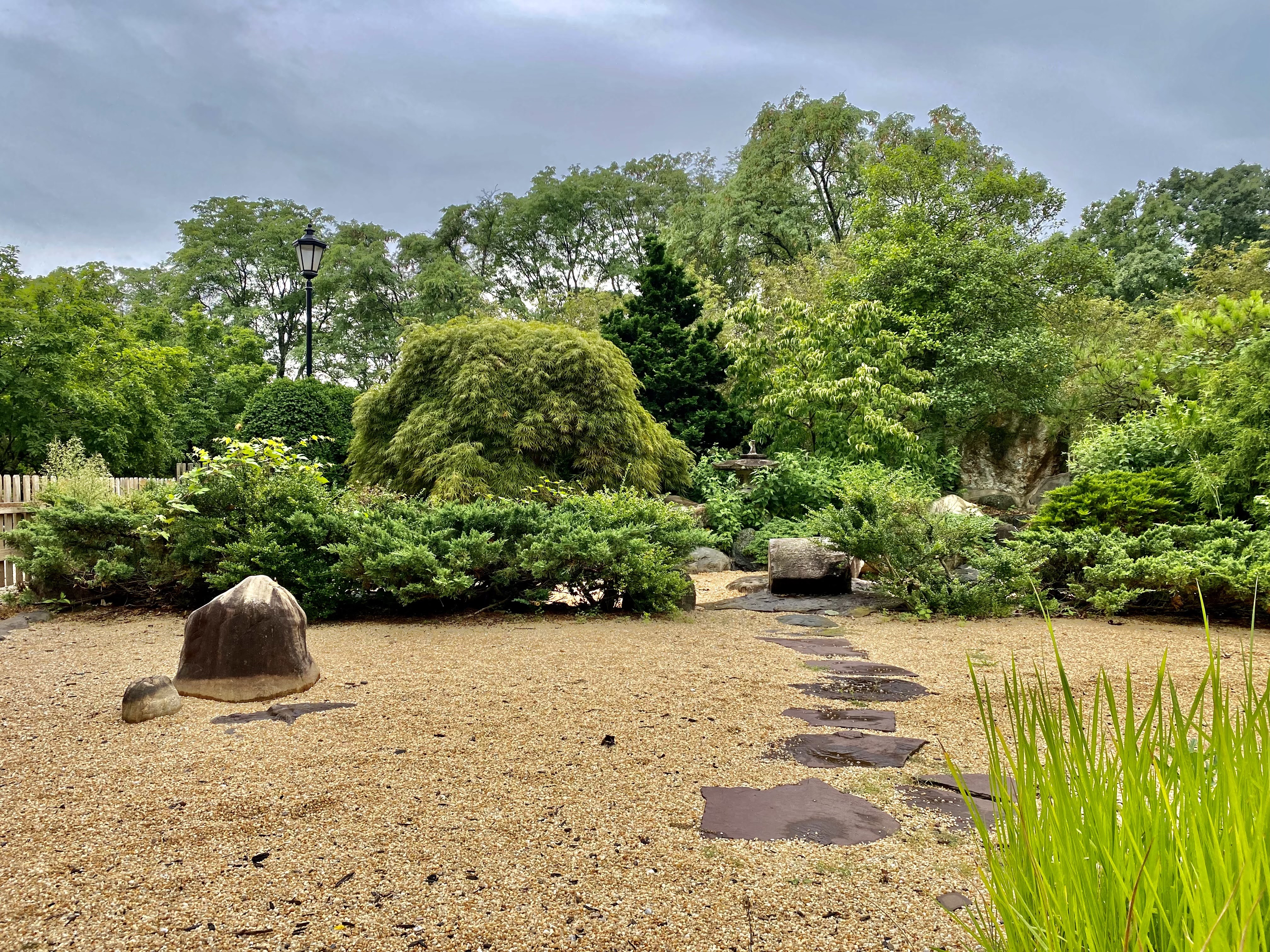
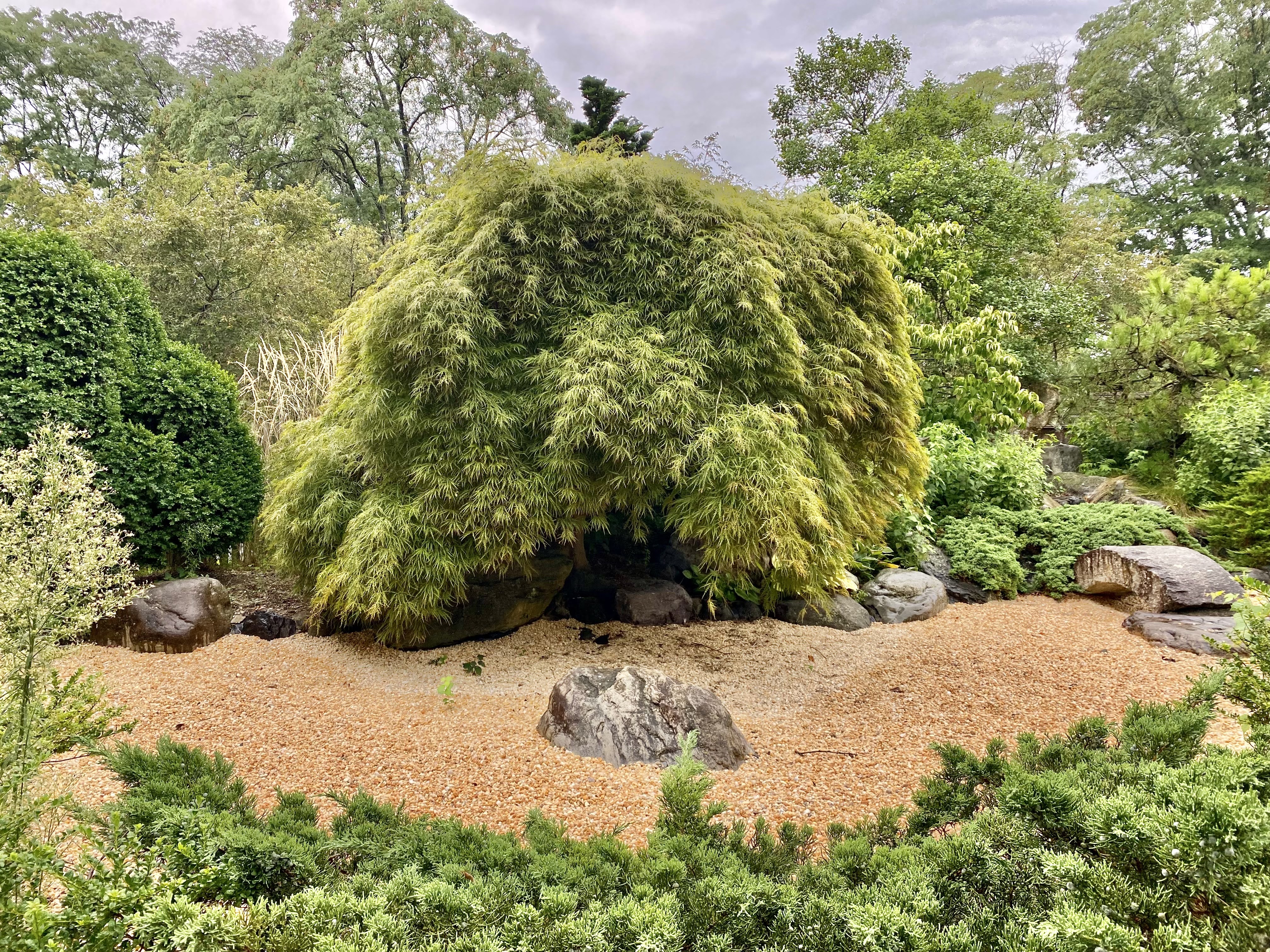
The plantings surrounding the gravel beds, and stone bridges has grown considerably since it was first built in 1971. As a result, the garden appeared overgrown and in need of some maintenance. 


It should be noted that the gravel bed in the following two images was a pond back in 2016. Its removal, unfortunately, undermines the authenticity of the garden.


Below is an image of the garden from 2014 and before the removal of the pond and the addition of a new dog-eared fence.

Source: Bethlehem Fine Arts Commission

The garden was clearly better maintained and the pond a significant feature of the garden.

The newly installed dog-eared picket fence now that surrounds the sides and front of the garden seemed out of place. I suspect the current fence was a cheaper money-saving alternative. 


I would identify the pond removal and fence changes as the major criticisms of the garden. The pond's absence removes a necessary water feature while the fence looks stylistically odd. However, more importantly, the fence and locked gate near the teahouse prohibits visitors from entering the garden and experiencing it directly. 

The fence essentially reduces the garden to a museum display and negates the purpose of a Japanese garden. The Itabashi Garden I recently visited in Burlington, ON, Canada, is similarly build adjacent to a public library, but it's design encourages visitors to view and walk through the garden. 

I understand the need to protect the garden from uninformed visitors and the role the fence plays in this regard. However, I would advocate for either a more authentic fence, or the planting of shrubs and plants that could act as a natural "barrier" to define the garden perimeter. Perhaps a designated entrance and separate exit-way could allow visitors to enter, stay on a path, and move through towards the exit. Also, without question, the pond should be reestablished. 

Correcting these mistakes would allow people to truly experience the joy of visiting a Japanese garden

Friday, August 19, 2016

Shofuso

Drove down to Philadelphia, PA to visit Shofuso (Pine Breeze Villa), a traditional Japanese Shoin style house and garden. The garden area has existed since 1876 and the current house and garden since 1958. 

The garden is ranked #3 by Sukiya Living Magazine (JOJG) on its top 25 list and is considered one of the most authentic in the Unites States. At first, I was skeptical, given that the garden is only 1.2 acres in size. However, after entering, I was surprised to discover that the garden lives up to its reputation. 


The House, in particular, is very authentic. It reminded me of several garden structures I had visited in Kyoto last year, especially Ryoan-ji. The grounds were also very impressive and well maintained. Many elements of a traditional Japanese viewing garden were present.


The entry way was simple and was shielded from the main garden and building by a hedge row of Japanese Holly, adding an element of anticipation as one moved closer into the grounds.


Once in the structure an onto the main viewing platform, one is presented with a spectacular view of the garden.


Being early morning, the garden and platform were bathed with direct sunlight - a bit harsh on the eyes and hot as well. Afternoon viewing might be preferable.


Near the back of the house, is an exit that leads towards the traditional bathing and toiletry areas, as well as a small tea room. A small stream passes through this area. I found the rough hewn traditional boards for the entry portion of the deck interesting.


An elaborately designed gutter system leads to a rain chain that feeds into the stream.


The view from the small tea room was breathtaking.


There were many other features, large and small, throughout the house and garden that enhanced the authenticity of the garden experience.


On the other side of the house, is the Tea Garden, the views from which are spectacular.


A small isolated island in the main pond, as well as a well stocked supply of Koi fish, added to the atmosphere of the garden. The pond was surrounded by Azaleas and Yews, with a few Hinoki Cypress mixed in as well.


The only downside was that the fence surrounding the main garden area was somewhat un-Japanese. It was based on a design used during the structure's original placement at New York's Museum of Modern Art in 1958. To me, these walls seemed reminiscent of Chinese rather than Japanese gardens. Also, the ornamental black iron fencing seemed a bit too contemporary, allowing one to see the road through the fence. There were also several overhead electrical wires nearby that were a bit of an eye sore.


Overall, I was pleased with the garden. It was well worth the trip. For anyone unable to travel to Japan, it should be a most memorable and authentic experience.