The Seven Springs Japanese Garden is part of the Seven Springs Gardens & Sculpture Park in Manchester, Vermont. I stumbled upon this garden while visiting Hildene, the summer estate of Robert Todd Lincoln. When searching for nearby gardens online, I came across the sculpture park but only realized it had a Japanese garden when looking at images from the website. If you search for "Japanese gardens in Manchester VT" it will not appear in a Google search. Once I realized its existence, I immediately changed my plans for my visit to Manchester.
The property, owned by Stan Stroup, includes a large sculpture garden in the field behind the main house. In addition, there is a woodland stroll garden alongside the Japanese garden. All of these gardens were the creation of Stan and his late wife Sylvia. The Japanese garden, designed by local architect Ray Smith, has many features associated with a traditional Japanese stroll garden. I was especially impressed with the plantings and overall garden design. Currently, the garden exists in that stage between new and mature. The grounds throughout were very well maintained and the periodic view of the nearby mountains added to its unique qualities. Opened to the public from June to September, the gardens are well worth a visit.
Arriving at the garden, one has the option to take an alternative path across a raised wooden platform into the nearby Woodland garden.
Choosing instead to enter the Japanese garden, one sees a mushroom-shaped English saddle stone, originally used to support the corner of a grain crib.
After crossing a small wooden bridge over a stream, one encounters a 1930s French art deco metal gate mounted in a torii-like timber frame.The garden is populated with a variety of water filled streams and "dry bed" stream features.
A Yukimi style lantern sits within a ground cover along the edge of the garden. I appreciated that the garden was not populated with an excessive amount of these type of features. Using a "less is more" approach helps to make the viewing experience more authentic.
The plantings throughout the garden walkways helped define the path, especially the use of grasses.
The naturally shaped Stukubai wash basis was a nice feature. The two anchoring pines in front are beginning to grow too large, and as a result, it takes some effort to see the basin. On the positive side, one could hear the sound of running water long before encountering the basin's location, adding an element of surprise to is eventual discovery. At some point in the near future, a decision about the pines will need to be made that will ensure that this "sacred" space remains an integral part of the garden experience.
The view of the small pavilion is remarkably beautiful. As you make your way through the winding paths, it slowly comes into view and its features more prominent.
The view looking out from within is spectacular. A most relaxing space.
The nearby bench demonstrated the Japanese influence in the woodworking throughout the garden's wooden structures.
Large stone steps and bridges added to the natural appearance of the pathways.
The elevated bridge alongside the Japanese garden leading to the Woodland garden fits in well as a border and acted as yet another platform from which to view the Japanese garden.
A nearby rustic lantern complimented the style of the raised walkway and the Woodland garden design. I have seen these type of lanterns used in other gardens, but often they are used in a way that is not consistent with the garden style - the right lantern must be placed in the right place. The use of a rustic lantern in this location is a wonderful exemplar of good garden design.
A curved bridge crossing the small stream was a nice feature that was inspired by Japanese style.
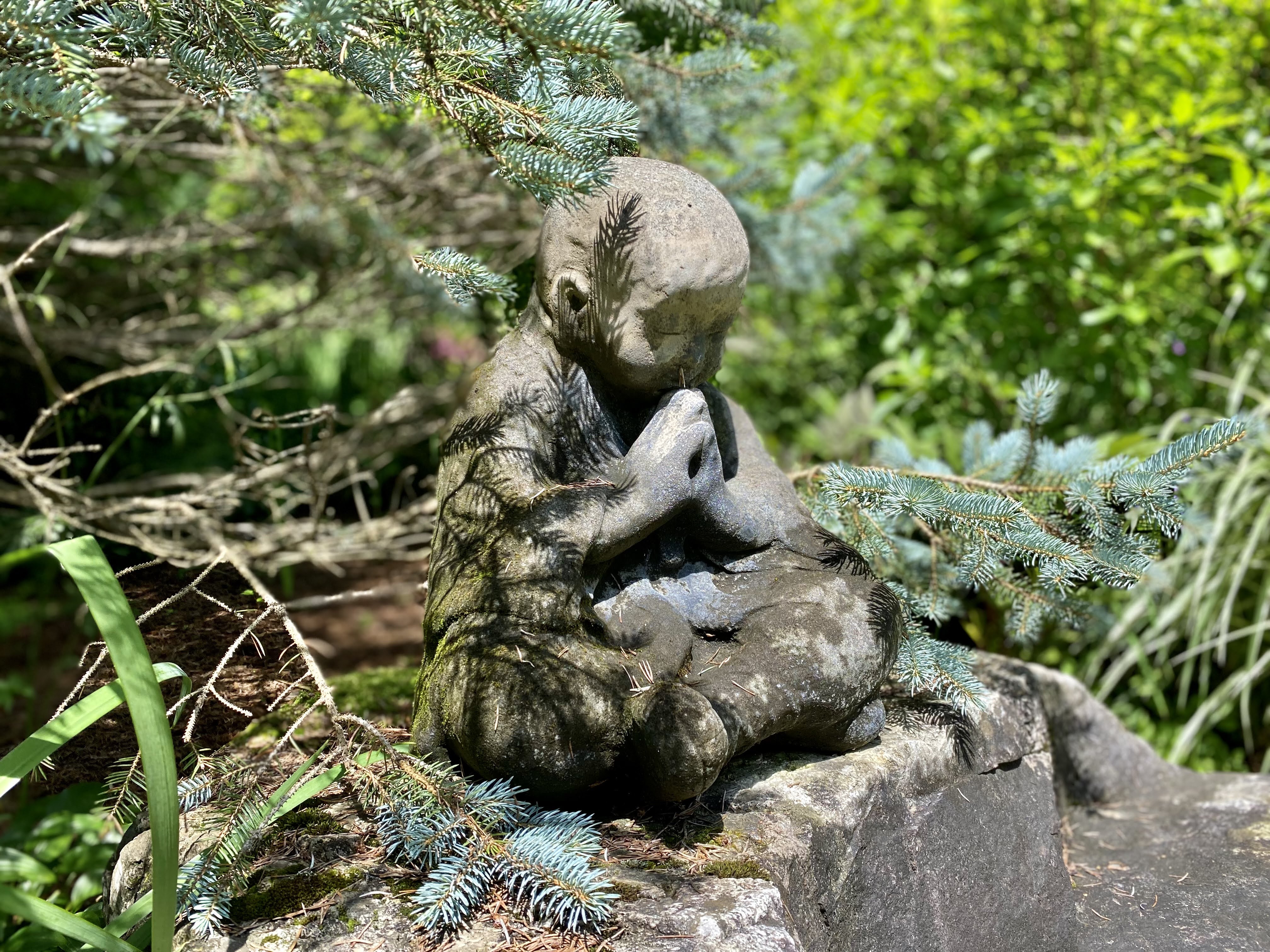
There were other features that were unique to this garden that I have not seen in other gardens, including a small stone statue of a Buddhist boy praying that was subtlety placed adjacent to the bridge pathway.
The one large lantern within the garden was placed in a location where three pathways transected. From multiple angles it was an interesting focal point, and the rustic style of the cut stone more reminiscent of a Sukiya style of Japanese garden.
The garden, seemingly more mature than when first created, consists of plantings that highlighted and complemented the pathways. Although I am sure it took a few years for this result to come to fruition, it now looks wonderful. The meticulous maintenance of the garden ensures that the pathways remain clear of overgrown obstacles. My favorite example was the use of Stonecrop Sedum as a ground cover beneath a Red Dwarf Maple. As a natural edging, it was mesmerizing to behold.
Overall, the Seven Spring Japanese Garden was a wonderful discovery. I now know I need to be more diligent in my search for gardens to visit.
My last minute discovery of the garden and the experience of walking its pathways was truly an enlightening experience.