Showing posts with label Connecticut. Show all posts

Saturday, August 19, 2023

Sleepy Cat Farm

Sleepy Cat Farm is the creation of Fred Landman who first purchased the property located in Greenwich, Connecticut in 1994. He then embarked on a decades long restoration and expansion of the home and gardens. The extensive gardens are without a doubt one of the most beautiful and well maintained garden properties that I have ever visited. Its size and quality dwarfs most well established private and public gardens, including some of the most noteworthy of botanic gardens that I have visited. 

For the purposes of this blog, I am only going to focus on the Chinese Pavilion and surrounding Asian inspired garden areas located at Sleepy Cat Farm. I initially discovered Sleepy Cat Farm via a cable television show called the Garden Chronicles (season 1, episode 3). Once I realized there was a Chinese pavilion, and that the garden was easily within reach of my home, I decided to visit as a participant in a Garden Conservancy Open Days event. My concern was that I would find only the pavilion, which by itself might not meet my criteria for my garden adventure list/blog. However, once I arrived on site, and directly headed to the pavilion (primarily to avoid the arrival of 700+ visitors), I discovered a much more extensive garden design that incorporated many aspects of Asian gardens. Pleasantly surprised, I realized it was going to be a long day.


Website: http://www.sleepycatfarm.com/

My first view of the Chinese pavilion was from the north end of a long serpentine hornbeam hedge, anchored at the north end by a large stature of Atlas (check out this map)

Source: http://www.sleepycatfarm.com/expanding-horizons/
(edited used without permission)

Atlas

As I made my way along this path way, the pavilion, which sits on a small island in the middle of a small pond, came into view. This is not the typical pathway for visitors, but is without a doubt the most dramatic - something I have never experienced within all of the gardens I have visited.


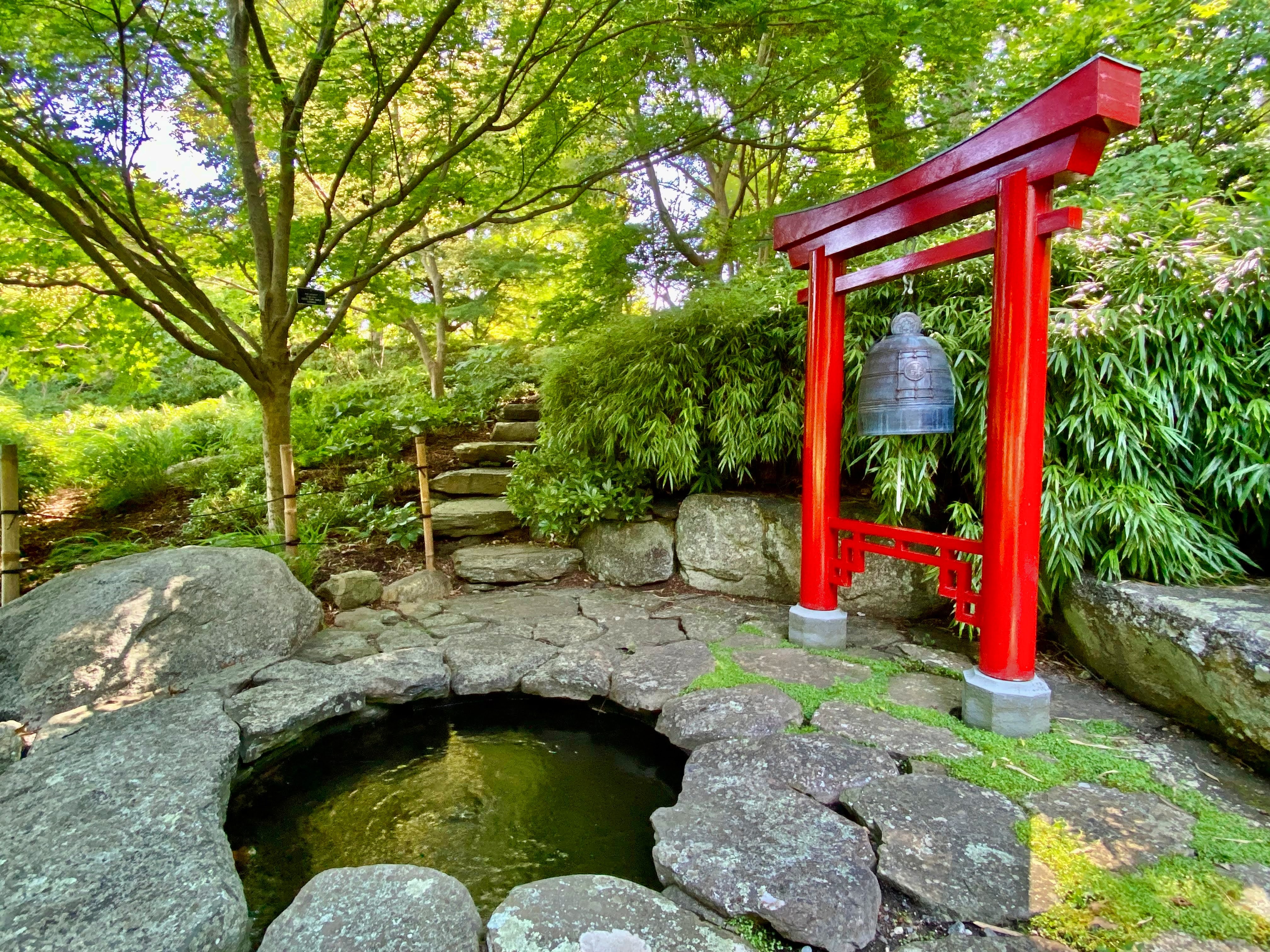
As I took in the view of the pavilion, it became clear that there was much more going on behind and above the pavilion. A series of stepping stones led to a variety of artifacts, including a small pool of water with a hanging bell.


A roofed structure with Buddhist prayer wheels also added some interest to the pathway.


Large decorative stones with a variety of details carved on the surface were also located along the pathway. These too could be spun as desired.


Several large lanterns and some statuary also populated the path.


Near the entry to the pathway rested a large basin resting upon a rock, its plantings catching my attention.


There were also several details within the pavilion pond and island which accentuated its 
appearance and contributed to the tranquility of the location.


More statuary, bells, and prayer wheels could be found along an additional path that led toward a nearby Iris Garden.


Nearing the entrance to the Iris Garden one last statue (perhaps Guanyin) marks the transition. After passing a bust of Buddha, one sees the Iris Garden, and after entering, one traverses a long and raised Spirt Walk which resembles a traditional zig-zag bridge, its terminus located at the beginning of the limonaia area of the gardens.


Overall, Sleepy Cat Farm is a masterpiece of gardening. The entire sight is overwhelmingly beautiful as well as inspiring. However, as far as my garden adventure is concerned, the Chinese Pavilion and its surrounding gardens are one of the most lovely and interesting Asian gardens I have ever visited.

A visit via a Garden Conservancy Open Day is recommended. The experience will transform any visitor and enhance anyone's love of gardening.

Thursday, August 30, 2018

Shôyôan Teien (Wesleyan University)


I had an opportunity to visit Shôyôan Teien of the Mansfield Freeman Center of East Asian Studies at Wesleyan University in Middletown, Connecticut.

The garden is located behind the Center and can be visited by entering through the front entrance. Once in, look for a small Japanese style room (Shôyôan - usually found in traditional Japanese homes). Once you enter, you can then view the garden (Shôyôan Teien) from within the room or exit onto a viewing deck (Engawa). However, do not enter or walk within the garden. It is not a Japanese stroll garden, but a viewing garden. One merely sits on the deck and contemplates what it would be like to walk through the landscape.

Website: https://www.wesleyan.edu/ceas/about/Japanese%20Garden%20and%20Tea%20Room.html


The garden was built in 1995 and was designed by Steven Morrell, and experienced Japanese garden designer and the garden curator of Shôyôan Teien. Funding for the garden was provided by the Freeman family whose long term support of the study of East Asia helped establish the Mansfield Freeman Center.

As usual, I am seeing a garden in summer - lots of green. This garden is best visited in spring and fall, when some color will emerge. I liked the rectangular shape of the garden, it reminded me of gardens I had visited in Kyoto and in some way my own backyard Zen garden. I would advise not visiting around noon time - the sun was directly above-center and was blinding. Photography was difficult with all that glare and It was unusually hot the day I visited - no contemplation for me, unless you consider heat exhaustion contemplation.

The garden was built in 1995 and it has evolved since then. There was, as there in every garden, the need for some weeding and plant maintenance, but overall the garden looked nice. I liked the winding nature of the path and the way it evoked the curving of the nearby Connecticut river.

Overall, Shôyôan Teien is a great garden and well worth a visit.

Garden Map:


Garden Map Source: https://www.wesleyan.edu/ceas/images/Japanese%20Garden.jpg

Photos: