Monday, August 25, 2014

Marble House - Chinese Teahouse

While visiting Newport, Rhode Island, I had the opportunity to visit some mansions, including Marble House. This mansion was built between 1888 and 1892 for William K. Vanderbilt as a "summer cottage." 

Website: http://www.newportmansions.org/explore/marble-house


Marble House 

On the grounds of Marble House sits a Chinese Tea House. 

source: http://meetings.newportmansions.org/venues.aspx?id=102

The Tea House was commissioned by Alva Belmont (divorced and remarried) in 1912. 


It opened on July 25, 1914 with a lavish Chinese costume ball at Marble House.

Alva Vanderbilt, seated, second from right

The Tea House was also used for rallies for women's suffrage. By 1919, the mansion and Tea House were permanently shuttered as Alva moved to France. 

Although the Tea House is based on a 12th century Song Dynasty temple, it is more characteristic of the wave of "Oriental Exotica" that spread across North America at the turn of the 19th-20th century. Many Japanese and Chinese style gardens were being built during this period, especially by the wealthy. These gardens had Asian characteristics, but were also reflective of late Victorian early 20th century tastes. The Tea House at Marble House is a good example of this movement.


The front gateway was interesting, especially give that the plaque at the top illustrates what appears to be an example of Confucian inspired filial piety. The male figure in the center is being shown filial respect by a daughter (left) and and son (right).


Monday, July 21, 2014

Chinese Scholar's Garden, Snug Harbor Botanical Garden

Took a trip out to Staten Island to visit the Staten Island, Snug Harbor Botanical Garden's Chinese Scholar's Garden.

寄興園
Jìxīng Yuán

This garden is one of only a few Chinese scholar gardens in the U.S. It was built back in 1999 from prefabricated parts made in China and assembled on site by Chinese workers from Suzhou.


I had the opportunity to visit it in 2000 when it was still new. At that time, there were few planting visible in the garden. Today, 14 years later, it looked very different. Plantings now cover much of the structure, but also make the environment within seem more authentic. The structure needs some repair work, but overall it is in very good shape.


In addition to the images below, I came across the following video-tour. It is worth a look because it gives an authentic feeling of what it is like to walk through the garden and it was filmed in the fall when the colors are spectacular.

Sunday, July 20, 2014

Japanese Hill and Pond Garden, Brooklyn Botanic Garden

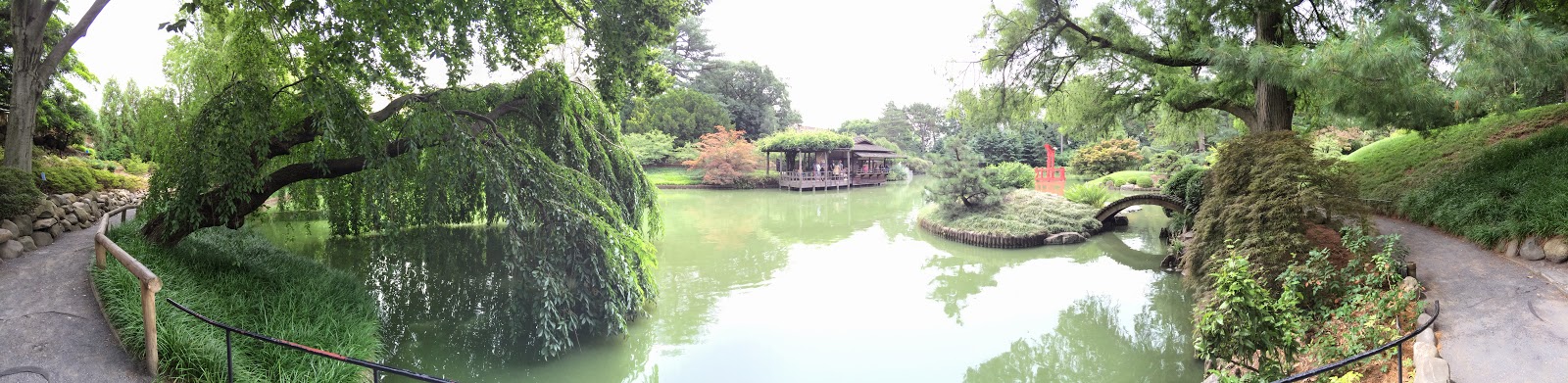
The Brooklyn Botanic Garden Japanese Hill-and-Pond Garden was built between 1914-1915, and was one of the first Japanese gardens to be included in an American botanic garden. The garden was designed by Takeo Shiota. It is the only surviving pre-World War I civic garden of its kind. The garden was restored in 1999, and today it is often found in lists of the best Japanese gardens in America.

There are a variety of features amongst its stroll paths, including bridges, pavilions a Shinto shrine, Torii Gate, and man made hills and waterfalls. 

Website: https://www.bbg.org/collections/gardens/japanese_garden


The entire garden is surrounded by a fence, one which uses bamboo poles as part of the upper screen.


A gate allows entrance into the garden and the viewing pavilion from which visitors can see much of the garden and lake.


The lake takes the shape of character shin ((心), or heart. Across the lake stands a Shinto torii similar in style to the one at Itsukushima. 


Torii at Itsukushima, 2007

The view from the pavilion also takes in a yukimi-style lantern near an high, rounded wooden drum bridge (taiko-bashi) that stands between a waterfall and tortoise island.


There is also a very impressive Kasuga style lantern lantern.


As one makes their way around the lake, additional views are experienced of the pavilion and tortoise island. 


This dwarf Japanese maple has clearly been growing here for some time to have become so large and shapely. 


Tortoise island with small arching bridge.


Yukimi-style lantern as seen from behind the tortoise island with stepping stones leading the way to this sacred space.


Higher up the hill is a man-add set of waterfalls and echo caverns (note the small tortoise on the rocks left of the water fall).


There is also a Shinto shrine located within the garden.


We then exited through a back gate into the rest of the botanic garden. near this gate was a plaque with an image of the garden when it was first built. It most defineatly looked very different:


For more historic images, check out the BBG Historic Image Collections.


After spending much of the morning in the garden, I went on to explore the Bonsai Museum.